
Don’t Lead with Code: How Developer Content is Evolving in 2026
Why the ‘How-To’ economy is collapsing and how to build what AI can’t.

Welcome to 2026, where the “Lead with Code” era in developer content has officially come to an end. The anatomy of developer content creation is changing right before our very eyes.
As a developer advocate, technical content creator, and educator, my strategy for creating content previously relied on search-learning. This cycle starts with the developer. They have a problem or want to research a topic, which leads them to search Google. They stumble upon Stack Overflow or a long-form YouTube video tutorial, copy the code, and use the solution to unblock their project. The cycle continues: I create content to educate based on developers’ search-based needs, but this transactional model of content is dying.
Today, in 2026, developers aren’t searching for syntax because it lives directly in their favorite AI-powered IDEs like Cursor, Copilot, or Antigravity. If developers don’t search, how can they find the blogs, videos, or forums? We’re currently in the zero-click era, where, as of May 2025, 83% of searches end without a click because AI summarizes the answer. Technical accuracy and brand/publication reputation used to be the differentiator, but AI-powered summaries are making them the baseline. If code isn’t the hook, and technical reputation isn’t a differentiator, how do we keep developers engaged with our content?
Hey, I’m Bree, and I find myself at an interesting crossroads of this change in developer content and consumption. First and foremost, I’m a developer who remembers copying and pasting my code errors or issues into Google and stumbling upon different Stack Overflow posts or blogs. That’s now been replaced with AI-powered searching that has context of my entire codebase or a prompt that simply says “fix this”. I’m a developer advocate who has built content creation programs to teach developers how to use complex enterprise tools. I’m also an independent technical content creator who loves sharing the joy of code with those outside of our bubble on platforms like TikTok, Instagram, and YouTube.
Today, I want to share my thoughts on how creating developer content is changing and where I think it could be headed. As someone who is constantly on both sides of the screen, I have seen that those who are willing to be unique and take risks with their content in 2026 are the ones who will succeed in reaching developers and growing their audiences.
Narrative as the New Documentation
Be honest…when scrolling on social media, are you more likely to stay for a video that starts with “Let’s discuss database permissions” or “Here’s how a database permission change literally broke the internet”? The first option may intrigue you, but only if you were already searching for information on database permissions. The second hooks you and immediately makes you ask more questions, like how did the content creator break the internet? Are they serious about breaking the entire internet? It may even make you think, been there, done that. The real difference in these pieces of content lies in how they’re composed.
Information has become a commodity. Anyone can use a search engine or an AI prompt to learn about database permissions, how they work, and even how they affect an individual’s unique codebase. This means the value now lies in provenance and experience. Developers don’t just want the what. We crave the good, the bad, and the ugly. Instead of content creation being a transfer of technical knowledge, it’s shifting to become a transfer of lived experiences, where we share the trade-offs and messy realities of being an engineer.
As technical content creators who are used to the search-learning cycle, we’ve gotten good at talking at developers – positioning ourselves as experts or heroes who save the day with the content we create. It’s time to make a shift. It’s time to start talking to developers and peeling back the curtain to reveal that it’s not magic or perfection behind the keyboard, but another human. This helps us move from creating a “happy path” tutorial to an “unhappy path” piece of content that’s real and resonates with our real-world experience.
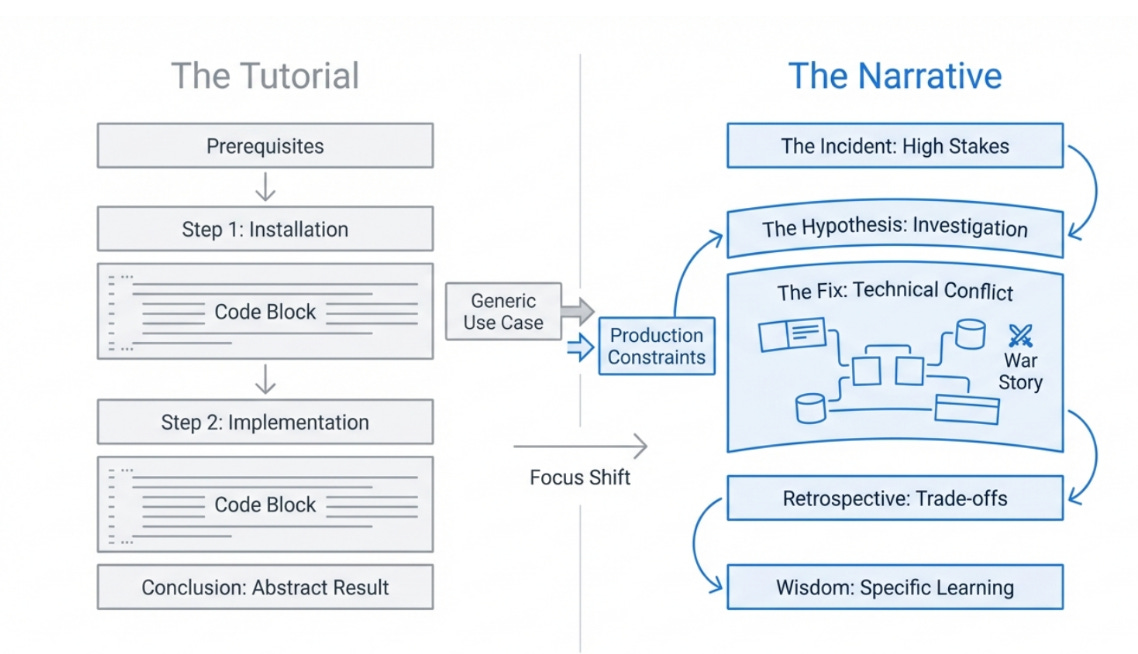
Engineering storytelling will become a key skill in 2026. Building in public isn’t a new concept, but it’s been doing exceptionally well on platforms like TikTok because it appeals to developers craving storytelling. Developers, founders, and entrepreneurs are building out lists of hundreds and thousands of potential users before their products launch because of their ability to craft a narrative around their development experience. I’ve also found that “building messy” on livestreams continues to excel because its casual nature resonates with engineers. In an hour, you can either build a new feature or debug a single issue. Either way, it reflects the real-life and problem-solving nature of developers.
A Shift in Medium: From Reading to Multitasking
There was a time when a good technical blog might get hundreds or thousands of views shortly after posting. In 2026, that isn’t exactly the case, and it’s actually sparked a debate between technical content creators on whether blogging as a medium is dead. I don’t think blogs are dead, but with the decline of search-based learning, they’re becoming the quiet infrastructure of the web rather than the go-to option.
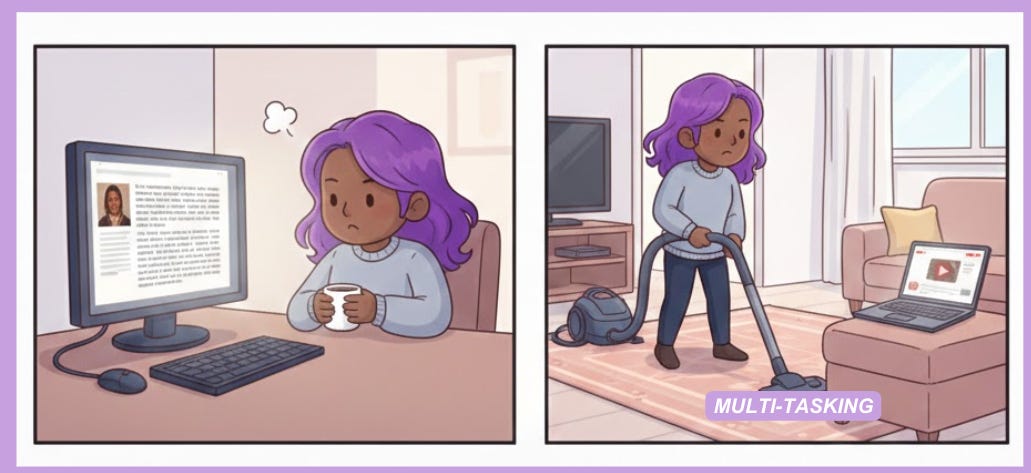
Studies show that 61% of developers now prefer video-based content over text tutorials. I believe this is for a variety of reasons, the main one being that we, as humans, are moving toward more dopamine-positive formats that also allow us to multitask. Developers can listen to a podcast or watch a video while completing a separate task. While actual productivity gains from multitasking are debatable, there’s an undeniable perceived boost that cannot be achieved when a developer is required to give a blog post their undivided attention.
Another reason some developers have moved away from using blogs as a primary source is that they’re trying to escape AI-generated SEO slop. I’ve seen creators use AI to generate complete articles stuffed to the brim with their desired keywords, simply for the sake of posting and to drive traffic to their target audience. While there’s nothing wrong with using AI to accelerate, we have to be honest with ourselves: when we want developers to care, we also have to care. This means putting more care into the content that’s created. It’s easy for an AI-generated article to lack the heart, opinions, and experience that can be conveyed in a video.
Instead of technical blogs being the primary source of developer news and opinions, they’re increasingly serving as training data for AI models rather than reading material for humans. They’re being served by AI chat tools as resources and are used for documentation. While blog views may be on the decline, another medium of snackable but high-impact media has been on the rise.
The “TikTok-ification” of Tech Education

The rise of bite-sized, bingeable content and platforms like TikTok has completely changed how we, as humans, view and consume media, from tech to news to entertainment. Its desire to hook viewers within the first three seconds and to constantly provide visual and audio changes to keep them engaged has created a new standard for what is engaging.
We’ve seen this change affect the film and TV industries, where bingeable 1-minute videos are preferred over traditional television show episodes, and it’s touched our industry as well. The hour-long code-along tutorials are being replaced by casual, unscripted formats. Casual learning content, or what I call code away from the desk, prioritizes the feeling of a casual coffee chat. This may be talking shop while whiteboarding with fun, engaging, or direct visuals. Another format that’s gained popularity is hooking viewers by completing another task (like cooking or making coffee) while you discuss a topic. These casual formats may feel like a departure from traditional DevRel content, but they work because the content doesn’t feel like work. This makes it easy for developers to consume in the hours they’re not in front of their IDE.
If short-form video is on the rise because of its quick time to value, what’s happening to long-form content like tutorials?
Honestly, the air around long-form content has shifted. We’ve seen well-known creators like Brad Traversy and Maximilian Schwarzmüller discuss that they’re moving away from the traditional coding tutorial format because viewership has declined sharply. It’s hard to justify spending twenty hours producing a deep-dive course when developers are increasingly using AI to generate the Day 0 boilerplate in a few seconds. There isn’t as much value in watching someone type syntax for hours. The time investment and ROI are actually what prompted me to start rethinking my own YouTube strategy.
However, I don’t believe long-form content is dead. I just think we have to be much more intentional about why we’re making it and who we’re making it for. It’s time to ask:
What is the purpose?
Are we educating in-depth on a specific architectural nuance?
Are we looking for engagement or adoption?
Are we directly solving a complex Day 2 problem that a 60-second clip can’t touch?
Are we trying to build a long-term community?
Understanding the intent of the content helps us decide the format, and it’s more imperative now than ever to understand who we’re creating content for. Having a true developer persona and understanding their journey through your app or tool, and knowing where they show up helps us answer these questions.
I often get asked if companies can get away with only doing long-form content these days. Is it possible for them to just skip the TikTok-ification and stick to traditional long-form video, webinars, and blogs? My opinion is a hard no.
Not if you want to expand your reach. If you only produce 45-minute webinars, you are only reaching the developers who are already deeply invested in your ecosystem. Short-form content is how you reach everyone else—the ones who don’t live on X/Twitter, who don’t spend their weekends eating, sleeping, and breathing documentation, and who consume their technical content passively during their daily lives. Short-form is your front door. It’s how you build awareness so that when they do have a problem worth a long-form deep dive, yours is the name they remember.
Here’s the thing: as we move into these shorter, more personal formats, the brand starts to fade into the background. People trust people. When developers are viewing the more casual and relatable content, they don’t always see the corporate brand or logo behind them. They see a human they can relate to. That brings us to an important shift: why developers are choosing people over brands.
It’s All About Trust: People > Brands
How many times in the past year have you landed on a technical blog post and realized within two sentences that it’s entirely written by an LLM? Sometimes it’s the AI-accent, but maybe it’s the realization that you’re just reading an SEO packed article written to drive clicks.

As developers, we have always had a pretty good BS detector, but in 2026, it’s been turned up to the max. We are currently being flooded with AI slop, generic content that lacks experience or emotion, that clogs up our search results and documentation. In this world of infinite synthetic noise, being unmistakably human has become a luxury brand. Our little flaws or slips in speech now almost verify that we’re real.
There is a very interesting line in the sand forming when it comes to facts versus opinions. When it’s a strict knowledge transfer (like checking the parameters for a specific library function), we generally don’t care if AI provided the answer, as long as it’s correct. It’s transactional. However, the second you want me to care about a tool, or a philosophy, or an architectural choice? You have to show me that you care first.
I’ve said this before, but it bears repeating: If we want developers to care, we need to care. We have to be strategic. We should be using AI to accelerate our workflows and handle the boilerplate or scaffolding, but we cannot let it replace the heart and soul of our content. When a brand lets an AI do the talking, they are signaling to the developer that their time isn’t worth a human’s effort. Trust with developers is incredibly fragile; it takes years to build and only one lazy AI post to shatter. Once you lose that technical credibility, it is nearly impossible to get it back.
This trust is deeply rooted in personality. Developers are humans, and humans like to see themselves, either who they are now or who they aspire to be, in the content they consume. This is why the tech bro problem in developer content is so damaging. When a brand uses a single, monolithic type of “model developer” as their face, it’s painfully obvious. We need diverse voices, lived experiences, and perspectives that reflect the actual community. We want to see the engineer who stayed up until 3 AM debugging, not a sanitized corporate avatar.
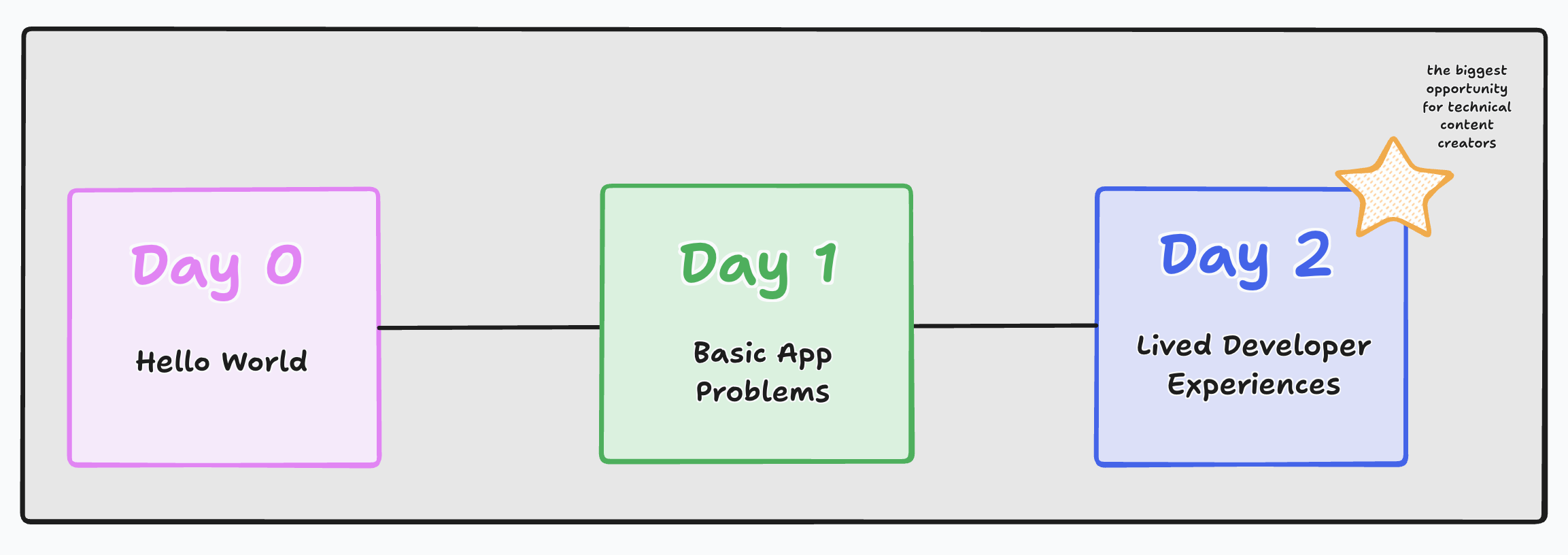
As we move into a future where AI handles the Day 0 (zero to Hello World) and Day 1 (Hello World to Basic App) problems, the real value for us as creators lies in Day 2. The hard stuff that comes with time and experience. The scaling, the refactoring, the team dynamics, and the security flaws that AI is too limited to catch. We are moving from being encyclopedias to being mentors.
As our role as mentors evolves, so does the way we actually approach learning. If we aren’t starting with a 40-hour deep-dive course anymore, where are we starting? That brings us to the “Just-in-Time” learning revolution.
The Just-in-Time Learning Revolution
Today, in 2026 is when a developer starts a new project, or even just tries to implement a new language or framework, their first stop isn’t usually a technical tutorial. It’s AI. Whether it’s ChatGPT, Claude, or an agent living directly inside their IDE like Cursor or Copilot, the “search and retrieve” loop has been replaced by “prompt and generate.”
This is the “Just-in-Time” learning revolution. We’ve moved away from the model where you spend weeks mastering every nuance of a language before you write a single line of production code, to a model where we only learn exactly what we need to get over the immediate hurdle in front of us. Developers don’t always want to know the deep, academic history of a tool; they want to know what’s going to get them to the next step of their project right now.
This shift has created an interesting new developer persona that we can’t ignore: the Vibe Coder.
Vibe Coders aren’t new in 2026, but they can create an interesting challenge for us as content creators: how do we support someone who is building software, but may not understand the foundational concepts that we’ve always taken for granted? This leads to a growing risk of “shallow building,” where software is shipped with functionality, but lacks the structural integrity that deep engineering knowledge can provide.
I don’t think the answer is to start creating completely different sets of content, one for traditional engineers and one for developers using our tools via AI. Instead, we have to be much more intentional about the level of developer we are trying to reach.
If we’re creating for the user who may not have traditional coding experience, our content needs to focus on things like orchestration and debugging AI hallucinations. If we’re creating for the traditional software engineer, we need to lean into deep dives and nuanced trade-offs that an AI agent might overlook. The middle ground, the generic “How to build X”, is shrinking, and it will require us to pick a lane for each piece of content we create.
This shift has made me start to rethink my own process in how I develop content programs and content as an independent content creator. I’ve spent the last few months re-evaluating everything from my format choices to my ideal follower persona, trying to figure out how to navigate this new landscape. Here is exactly what I’m doing personally to adapt to the 2026 reality.
My Developer Content Strategy for 2026
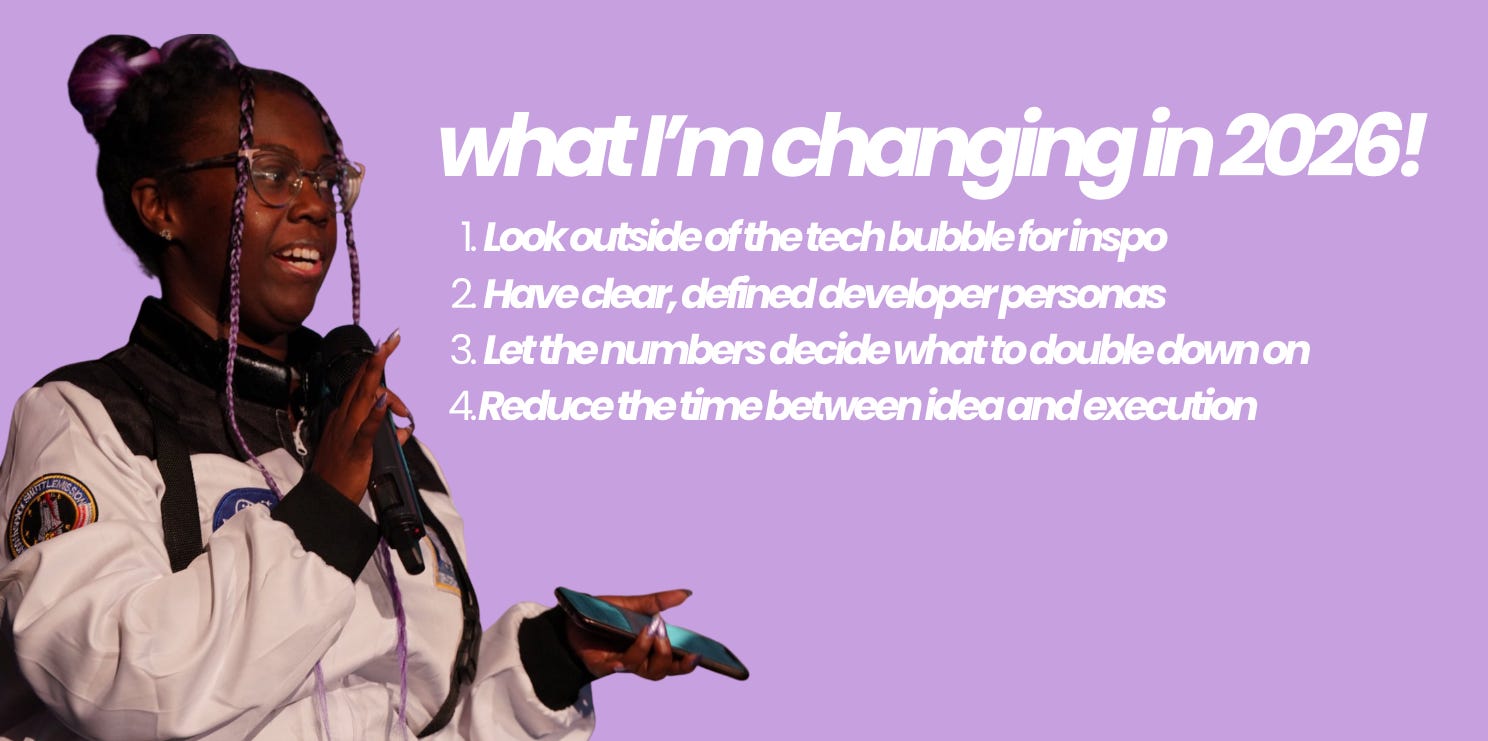
So…what am I actually doing about all of this? I think it boils down to two things: how I show up and how quickly. 2026 is the year of experimentation.
First, I’m looking outside of the tech bubble for inspiration. We tend to get really comfortable in our DevRel style, but I’ve found it can be an echo chamber. Some of the most effective storytelling and engagement strategies are happening in lifestyle, news, and entertainment niches. I’m taking those strategies like the hooks, the pacing, the visual storytelling, and mapping them to technical use cases. If we want more top-of-funnel exposure, we have to stop making content that only appeals to people who already have five years of experience in our specific stack.
Second, I’m no longer creating “catch-all” content. If you try to build something for everyone, you end up serving no one. I’m reexamining my ideal follower and developer personas and getting much more intentional. Every piece of content I create now has an assigned persona. Am I talking to a Vibe Coder looking for velocity? Or a Senior Engineer looking for deep architectural trade-offs? Is this a long-form deep dive or a short-form piece of edu-tainment? By defining the target before I hit record or start typing, I ensure the value is sharp and specific.
Third, I’m letting the numbers make decisions. I’m spending a lot more time looking at the numbers – video retention graphs, average view duration, and engagement patterns. If people are dropping off early, I need to know why. Is my hook too long? Is the middle too dry?
My biggest change will be reducing the time between the idea and execution. This is huge for me. In the past, I’ve added content ideas to a backlog and waited to publish. No more! I’m getting started quickly, fast, and dirty. I’m experimenting more than ever, and when I find something that sticks, I’m doubling down. The world is moving too fast for a month production cycle for a single video.
At the end of the day, my goal is to educate developers where they are. Using my own viewing patterns as an example, I can see that even my patterns have changed. In order to continue creating impactful content that educates and drives adoption, I must move to developers. The organizations and creators growing and getting noticed in 2026 are the ones taking risks on real content.
Stop trying to be a better search engine than ChatGPT; start being a better human storyteller!
Hey, great article!
I'm a little dubious about the "61% of developers now prefer video-based content over text tutorials" claim though. It's not clear where www.amraandelma.com get that stat from, but I'm willing to bet it's: https://survey.stackoverflow.co/2025/
But that says something different. It's under "Respondents learning to code use YouTube for community more than professional developers" and the 61% is a ranking of community platforms. YouTube is high, and it is above other text based platforms, but I don't think this says anything about tutorial preferences. It's also a bit hard to believe how high Stack Overflow scores, but I guess that's the bias (only people that use StackOverflow filled in the survey).